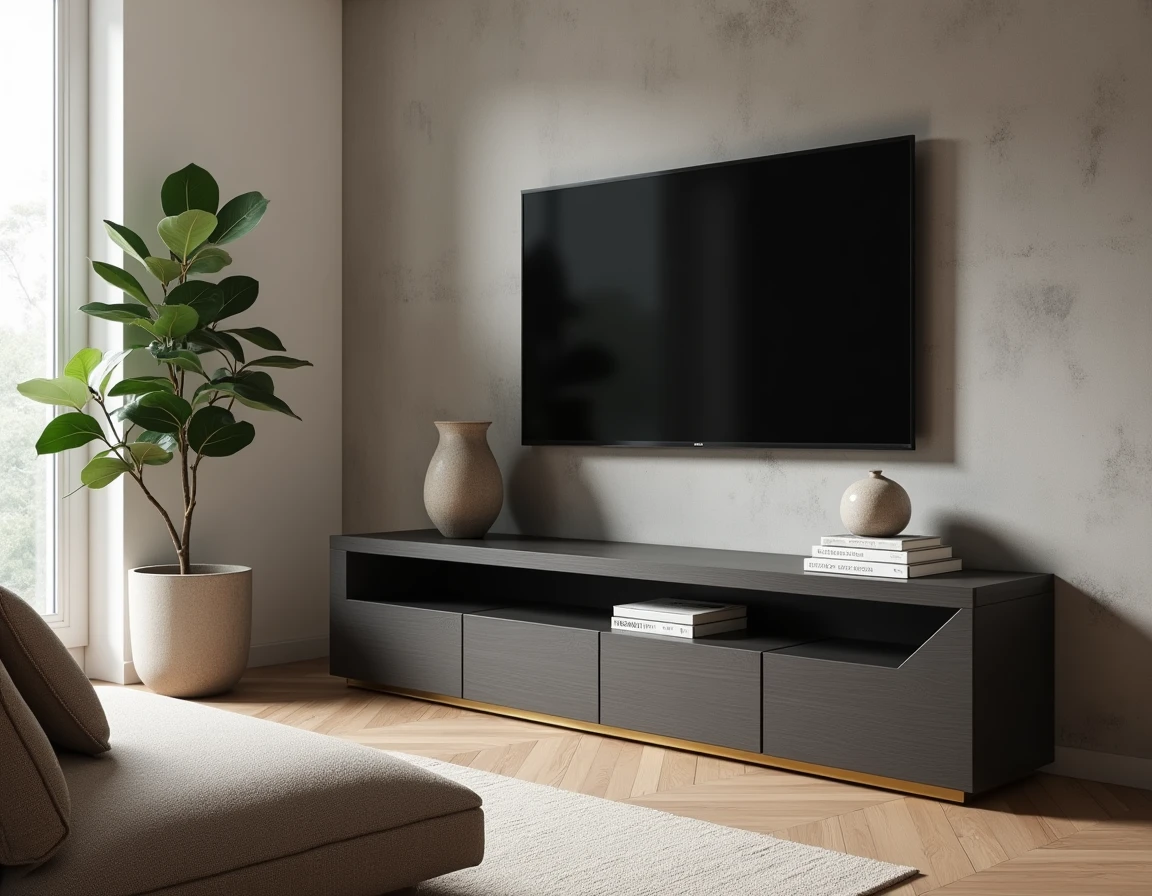
An corner TV unit refers to a piece of furniture designed to fit into the corner formed by two adjacent walls, utilizing a space that most linear arrangements leave vacant. In 2026, this format regains relevance due to the evolution of living room layouts, where the television migrates to a corner to free up the main walls.
Wall-mounted corner TV unit: how free floor space changes the perception of the living room
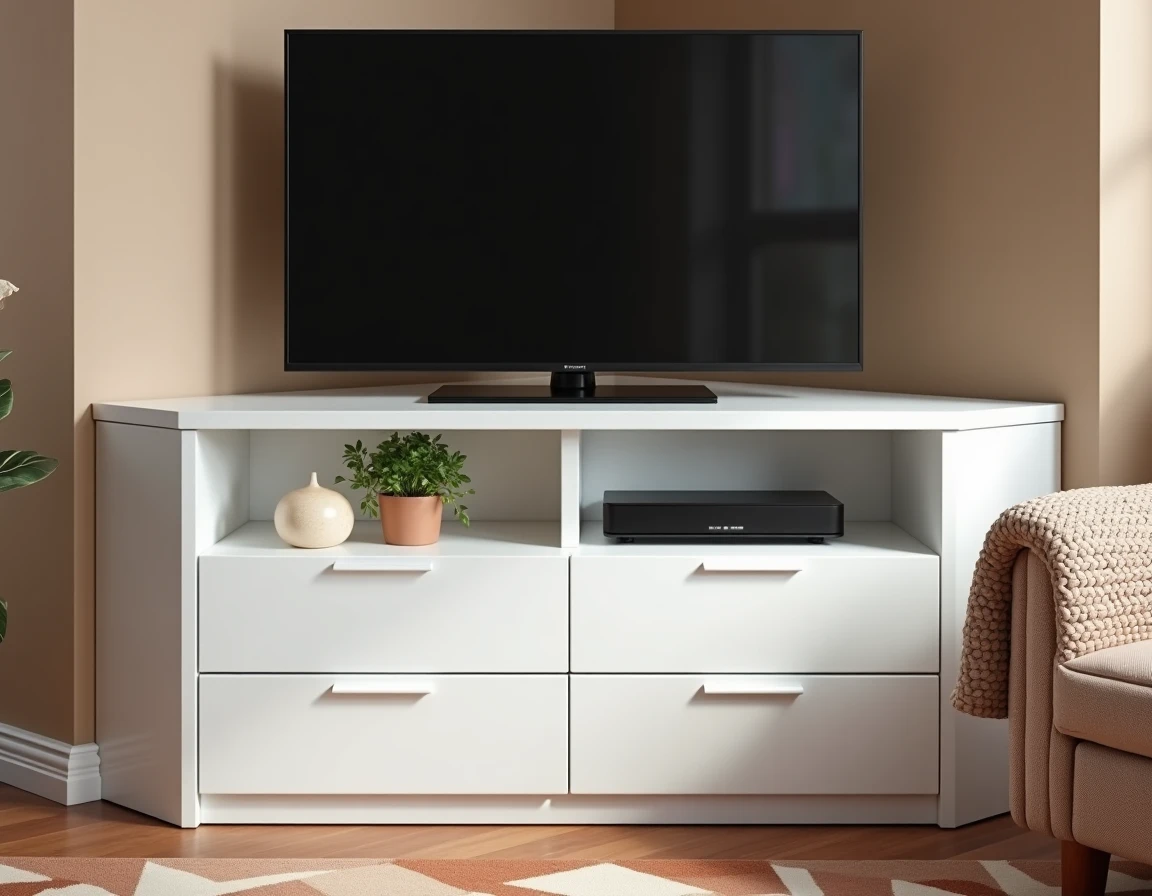
The wall-mounted design of a corner TV unit, whether suspended or semi-suspended, eliminates any contact with the floor in the corner area. The visual gain goes beyond the mere centimeter recovered: a wall-mounted TV unit visually lightens the entire room, especially in small spaces where every wall surface matters.
Cleaning under the unit becomes trivial, which may seem trivial until one realizes the amount of dust trapped behind a floor-standing unit in a corner. The suspended format structurally resolves this issue.
In modest-sized living rooms, this configuration frees up enough floor space to slide in a basket, a small side table, or simply to let the space breathe. The dkomdeco trends for the modern living room confirm this shift towards airy volumes and floating lines.
Reconfiguring the living room without a corner sofa: the TV migrates to the corner
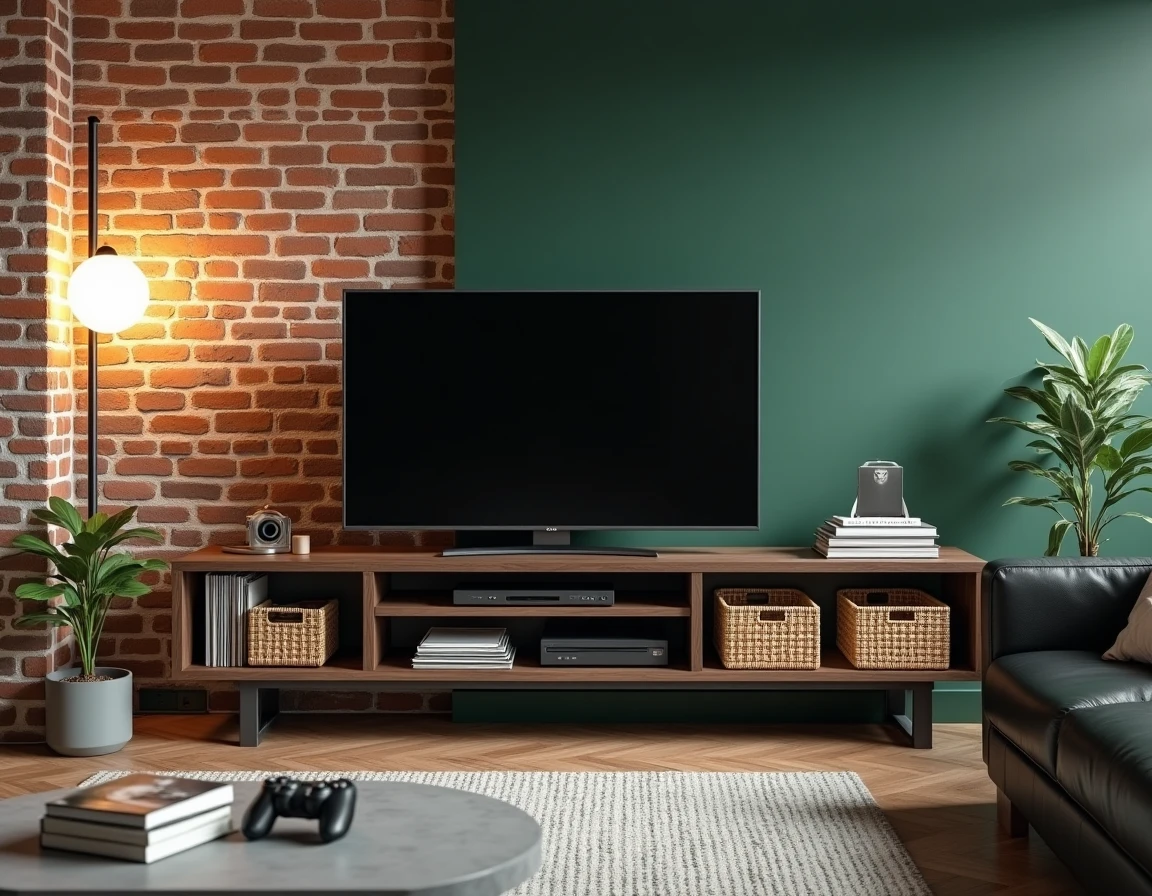
In 2026, several decorators and Francophone decor media report a significant decline in corner sofas. The arrangement replacing it, two sofas facing each other or positioned at a slight angle, opens up circulation in the living room and radically changes the logical placement of the screen.
When a large corner sofa occupied a corner, the TV was often placed opposite, on a straight wall. Without a corner sofa, the TV naturally slides into a corner to avoid monopolizing an entire wall, which restores a more convivial function to the living room, less centered on the screen.
The corner TV unit then becomes a layout choice, not just a furniture choice. It complements a living room designed for conversation as much as for viewing.
Corner TV unit and integrated desk: the hybrid use of the living room in 2026
The living room serves as a living space, an occasional office, a video game room, sometimes all three in the same day. The corner TV unit offers a structural advantage to meet this versatility: its V or L shape allows for the integration of a side work surface without encroaching on the rest of the room.
Specifically, one side of the unit accommodates the screen and the decoder, while the other side provides a work surface or closed storage for a laptop. This hybridization of TV unit/workstation remains very underutilized in current catalogs, even though it corresponds to the actual use of most living rooms.
Criteria for a multifunctional corner TV unit
- The depth of the side surface must be sufficient to place a keyboard and mouse without encroaching on the TV area, which requires a return of at least a few dozen centimeters
- The passage of cables between the screen area and the desk area requires integrated conduits or openings at the back of the unit, otherwise visible wires will be present in the corner
- A closed storage (door or drawer) on the desk side allows for hiding work materials in the evening, to restore a living room dedicated to relaxation
Materials and shapes of the corner TV unit: wood, curves, and metal finishes
The decor trends of 2026 favor natural materials and tactile textures. Wood remains the dominant material for TV units, but finishes are evolving. Raw wood or dark-stained wood facades coexist with brushed or chrome metal elements that provide contrast without weighing down the design.
In terms of shapes, the sensory design of 2026 pushes towards organic lines. Curved surfaces and slightly bulging facades are gradually replacing strict right angles, including on corner units. This evolution softens the sometimes rigid geometry of the wall corner.
Choosing between minimalism and visible storage
Two schools of thought coexist. The minimalist corner TV unit focuses on smooth facades, without handles, with pressure-opening mechanisms. The storage is entirely concealed, which suits streamlined living rooms.
The alternative involves integrating open niches or asymmetrical shelves into the unit. This creates visual relief and allows for the display of a few decorative items, but requires discipline in organization to avoid a cluttered effect.
- Closed facades: clean appearance, easy maintenance, suitable for small spaces where even the slightest visible object creates perceived clutter
- Open niches: allow for varying heights and break symmetry, but accumulate dust more quickly
- Mixed combination (closed low drawers, open high shelf): the most common compromise, which works in most corner configurations
The choice of material also influences the perception of space. A corner TV unit in light wood or beige tones blends in more than a model in dark wood or black lacquer, which visually anchors the corner and makes it a defined focal point.
The corner TV unit in 2026 is no longer a compromise reserved for rooms too small for a straight unit. It is a choice of living room layout, dictated by the new way of arranging seating and by the versatility required of a unique living space. The suspended format, natural materials, and integration of a desk function make it a piece of furniture that structures the corner rather than merely occupying it.